The world that makes a wolf
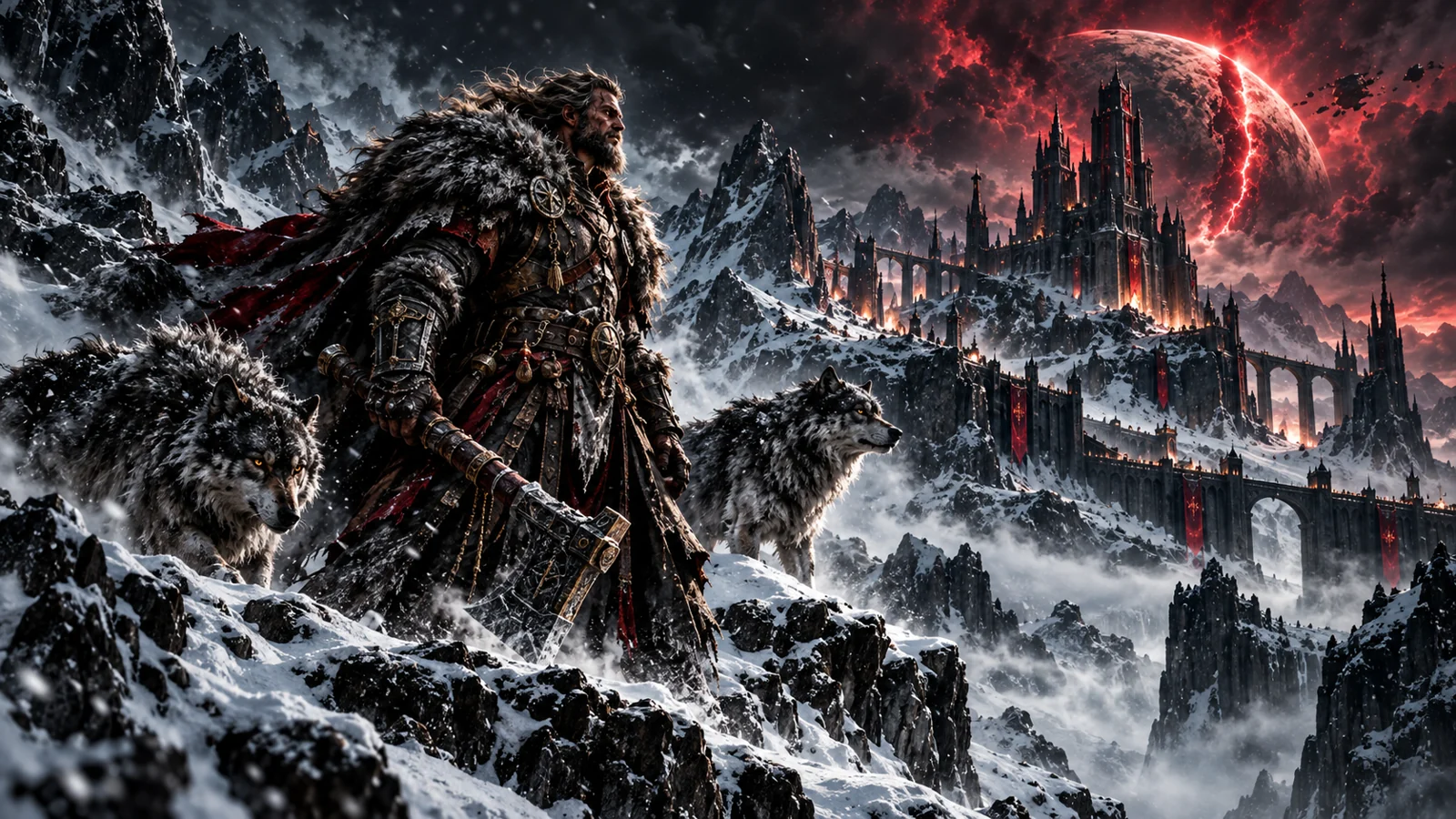
Fenris does not offer anyone an easy childhood. In the fiction of Warhammer 40,000, it is a lethal world of immense oceans, volcanic activity, moving ice, and tribes whose lives are shaped by survival. Its harshness is more than decorative scenery. Fenris helps explain why the warriors recruited there place such weight on loyalty, courage, storytelling, and the bonds formed in danger. Before we meet gene-seed or power armour, we meet a culture of people who live near the edge of a world that seems determined to destroy them.
That matters because the Space Wolves are not simply standard Space Marines dressed in pelts. Their identity starts with a human society whose customs continue to shape its genetically transformed champions. The stories of Fenris are sung, remembered, retold, and sometimes contradicted. A saga is both a record and an argument about what deserves to be remembered.
The Emperor's executioners
The Space Wolves trace their origins to the VI Legion, one of the Legiones Astartes created for the Emperor's Great Crusade. Their Primarch is Leman Russ: the Wolf King, a formidable commander whose apparent wildness often conceals political awareness and brutal strategic purpose. Like the other Primarchs, Russ was separated from the Emperor early in life and raised far from Terra. His discovery on Fenris connected the VI Legion to the culture that would make it instantly recognizable.
The Legion earned a reputation as the Emperor's executioners, a phrase that points to the ugliest part of Imperial power. It is tempting to read this as uncomplicated heroism: warriors entrusted with terrible assignments because they are capable of finishing them. But Warhammer rarely lets that idea sit comfortably. Who gets to decide an execution is necessary? What happens when obedience and honor point in different directions? Russ's story becomes richer when those questions are allowed to remain uncomfortable.
Brotherhood before bureaucracy
Many Space Marine Chapters are presented through strict organizational doctrines, precise heraldry, and inherited structures. The Space Wolves maintain traditions that make them distinct. Their Great Companies are associated with individual Wolf Lords, and their hierarchy includes figures such as Wolf Priests and Rune Priests. The exact details change across eras and publications, but the broad character persists: personal bonds matter, distinctive heroes lead, and names become stories.
A Space Wolf's public identity is often built from deeds. To outsiders, the boasting and feasting can sound like arrogance. Inside the culture, stories preserve memory and establish expectations. A warrior who claims great courage may eventually have to prove it. The heroic posture is also a burden.
The Great Companies provide a useful starting point for new readers because they show how a single Chapter can contain different personalities without losing its collective identity. This is not a perfectly uniform force marching behind one interchangeable symbol. Different leaders cultivate different traditions and strengths.
Wolves, but not werewolves
The wolf imagery is everywhere: in titles, rituals, ornamentation, and stories. Yet the Space Wolves are not a simple werewolf faction transplanted into science fiction. They are transhuman soldiers whose bodies have been reshaped for war. Their gene-seed carries distinctive traits, including the Canis Helix, and the lore repeatedly explores the costs of that inheritance.
The Wulfen are one of the most unsettling manifestations. Their feral transformation complicates the proud language of superior warriors and noble bloodlines. It makes literal a tension that is present throughout the faction: what separates ferocity controlled by duty from ferocity that overwhelms the person wielding it?
That tension is a powerful reason to read Space Wolves stories rather than merely inspect a miniature army. Beneath the spectacle are questions about inheritance, identity, and who gets considered fully human in an empire obsessed with purity.
The Thousand Sons and the price of certainty
No introduction to the VI Legion can avoid Prospero. During the Horus Heresy era, conflict involving the Space Wolves and the Thousand Sons becomes a defining tragedy. A very compressed version says that Russ's warriors attacked the world of Magnus the Red, Primarch of the Thousand Sons. A more useful reading asks how orders, distrust, manipulation, pride, and the psychic politics of the Imperium drove that disaster.
Prospero is not a comfortable story in which every participant cleanly understands what is happening. Its repercussions spread into the Heresy and beyond. For new readers, this is a signpost rather than a spoiler-heavy summary. When we eventually devote a full chapter to Prospero, we will follow the political and emotional stakes in sequence.
What makes them compelling in the 41st millennium?
The Space Wolves are among the best examples of Warhammer's collision between myth and machinery. Imagine a longhouse saga transplanted onto the deck of a starship; the language of kings and oaths housed within an empire of orbital bombardment and engineered warriors. Their battles feel ancient and futuristic at once.
They also embody a contradiction. They belong to the Imperium, a regime notorious for coercion and cruelty, but their fiction sometimes emphasizes bonds with ordinary people and resistance to certain Imperial institutions. Neither element erases the other. The possibility of both at once is the interesting part.
The setting is often described as grimdark, a universe in which even sympathetic figures serve institutions with frightening ambitions. Learning the Space Wolves means resisting the temptation to flatten that complexity into either simple villains or untouchable heroes.
Reading the Chapter, not just the battles
A newcomer might assume the best place to begin is a dramatic fight. Battles are certainly part of the appeal, but the most revealing scenes can be quieter: a warrior remembers a promise, an older hero challenges a young one, or a story about honor collides with a command that demands obedience.
If you explore more 40K fiction, keep three questions nearby. What does this character believe loyalty requires? Which traditions are helping them understand the world, and which are trapping them? And how much of this account is history, legend, or a boast polished by years of retelling?
Those questions turn lore into a world rather than a spreadsheet of weapons and victories. We will return to Fenris in later chapters when we encounter Russ, the Heresy, the Thousand Sons, and the strange fate of the Wulfen.
Your route forward
This first chapter is a doorway, not the final word. Our next stop is the wider Adeptus Astartes: where the Space Marines came from, what a Chapter is, and why the Imperium relies on superhuman warriors even as it fears the power they wield.
For now, remember one thing about Fenris. In a galaxy filled with towering armour, ancient machines, and impossible wars, the Space Wolves still explain themselves through human stories. That is both their greatest strength and a source of endless conflict.